Published on January 16, 2026
As 2026 begins, healthcare leaders are no longer preparing for CMS-HCC V28 they are now operating with it as the risk adjustment model governing performance and payment calculations The full adoption of the V28 risk adjustment model marks one of the most significant structural shifts in modern Medicare risk scoring, with implications that extend across finance, clinical operations, contracting, and care management.
More than an incremental update, V28 fundamentally redefines diagnostic logic, compresses HCC categories, and redistributes weight across chronic conditions. For organizations bearing financial and clinical accountability, the question in 2026 is no longer whether the model will reshape performance but how effectively they can adapt to it.
With V28 now governing risk scoring and payment logic, historical performance evaluated under V24 can no longer be relied upon without translation. Many organizations entered 2026 recognizing that assumptions built on prior models offer limited predictive value in the current environment.
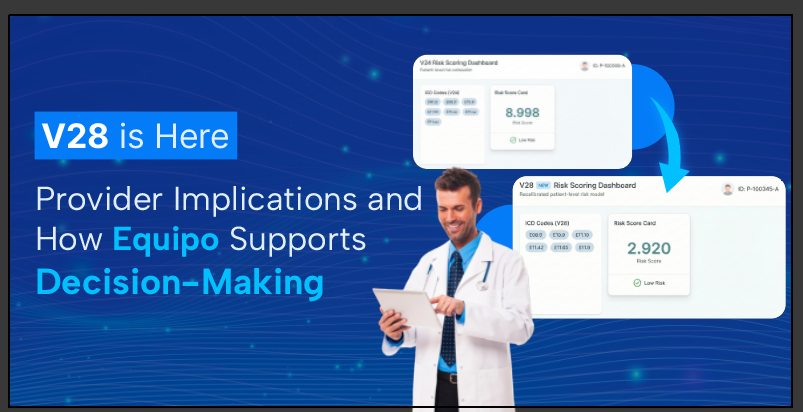
This is where model-specific intelligence becomes essential. Tools capable of analyzing patient populations under both V24 and V28 frameworks provide leaders with the clarity needed to reconcile year-end 2025 results with 2026 performance expectations. Equipo’s risk analytics engine was designed precisely for this moment, enabling side-by-side comparison and patient-level insight that reflect real population behavior not legacy assumptions.
The defining feature of V28 is its structural reset. The model completes a multi-year transition by consolidating HCCs, refining hierarchies, and eliminating interaction effects that previously inflated scores. As a result, many organizations are seeing immediate changes in projected RAF values even among stable, well-documented populations.
In 2026, clinical teams, coders, actuaries, and risk-bearing providers must operate with the understanding that historical trends no longer carry the same predictive strength. Performance planning now depends on V28-specific forecasting rather than extrapolation from prior years.
One of the most visible market-wide effects of V28 is the downward shift in average RAF scores. As organizations assess early 2026 data, this compression is becoming the new baseline rather than an exception. Contributing factors include:
For finance and strategy leaders, this recalibration requires adjustments to budgets, revenue expectations, and long-term sustainability planning. The organizations adapting most effectively are those that anticipated this shift and aligned their operational models accordingly.
ACOs and delegated provider groups are among the most impacted in 2026, particularly those serving medically complex populations. Even without changes in patient acuity, benchmarks and shared savings calculations may reflect reduced revenue potential under V28.
In this environment, financial predictability hinges on the ability to quantify V28 impact accurately and early before variances materialize at reconciliation.
While V28 structurally reduces risk weights, documentation accuracy in 2026 plays a critical defensive role. Accurate, compliant capture is now essential to prevent avoidable RAF erosion.
Coders, CDI teams, and clinicians must align workflows with V28 logic, particularly around:
Organizations that refined CDI strategies early in 2026 are already seeing greater stability compared to peers relying on legacy documentation practices.
As organizations recalibrate for the year ahead, precision insight has become a differentiator. Equipo supports this shift through a dedicated V24–V28 comparison framework that clarifies how individual diagnoses, patient segments, and documentation patterns behave under the new model.
Its analytics identify where RAF volatility is most likely, where documentation gaps carry disproportionate financial impact, and how population-level shifts influence 2026 revenue expectations. Beyond scoring, Equipo’s patient engagement capabilities surface cohorts most affected by V28-driven changes, while its Quality of Care module highlights clinically meaningful gaps that warrant prioritization.
Together, these insights give finance, contracting, clinical operations, and care management teams a shared, evidence-based view of what 2026 demands replacing assumption with clarity.
As RAF compression tightens margins, utilization management has taken on heightened importance in 2026. With less financial cushioning, preventable utilization now carries amplified impact.
UM teams are increasingly focused on:
Success in 2026 depends on early visibility into which patients require proactive, intensive outreach.
V28 has made clear that not all high-risk populations are affected equally. Certain segments such as advanced cardiometabolic patients and multi-chronic elderly populations continue to correlate strongly with medical spend despite reduced RAF values. Others, once considered high-risk, now generate lower scores without a corresponding drop in care needs.
This mismatch requires:
Organizations that realigned early in 2026 are better positioned to maintain care quality while controlling avoidable utilization.
The transition from 2025 planning to 2026 execution has underscored the importance of foresight. Leading organizations entered the year having already:
Planning against V24-derived expectations has proven insufficient. Precision forecasting is now a prerequisite for stability.
Organizations that integrated V28 analytics into decision-making before the start of the year are already seeing tangible benefits clearer financial projections, stronger negotiating positions, and more targeted clinical strategies. Those that acted during the transition window entered 2026 with reduced uncertainty and greater operational confidence.
The year ahead will reward accuracy, adaptability, and tools purpose-built for V28 logic.
While V28 represents a meaningful structural change, it also offers an opportunity: a more clinically aligned and equitable approach to risk representation. Organizations that embrace model-specific insight are not merely absorbing the shift they are using it to refine care delivery and strengthen financial resilience.
Equipo’s V28-focused analytics, population stratification, and V24–V28 comparison capabilities equip teams with the precision needed to succeed in this new environment. With the right insights and early action, 2026 becomes not a year of disruption, but a year of strategic clarity one that supports better decisions, stronger operations, and improved care for the patients who rely on them.
Explore other articles and announcements from our team.